
Sunday, July 6, 2008
Possible Answers
Here are my answers to the questions that I posted about croc scaling. The 16 foot saltwater croc that lives in saltwater would be about 640 lbs (twice as long, but eight-times heavier), where the 16 foot saltwater croc that lives in freshwater would be about 1200 lb. In fact, Thomas caught a 16 footer in a freshwater lagoon in Costa Rica that was about 1200 lbs. I think that the osmotic stress imposed by being in saltwater may have a significant enough cost that american saltwater crocs that live in saltwater don't have as much energy available to grow as the individuals that live mostly in freshwater.


Thursday, July 3, 2008
Scaling
We got a croc last night! Here is its mug-shot. 
I don't have time to do a full post yet. Plus, we may get another one tonight. The croc was about 8 feet long. Thomas and I think that it was about 80 lbs. Here's a scaling question for my biology majors: Assuming that these crocodiles scale isometrically and all 8-footers are about 80 lbs, about how much should a 16 foot crocodile weigh? (Interesting aside: snails make up much of the diet of many big Morelet's crocodiles caught on the mainland.) The saltwater crocs that live mostly in fresh water in Central America tend to be larger than the saltwater crocs that spend much of their time in salt water. All of the crocs tend to take advantage of hanging out in fresh water when they can. An 8-foot salty that lives in fresh water would weight more, approximately 150lbs. How much, assuming isometry, would a 16-footer living in fresh water weigh? Why might the american crocodiles that live in fresh water be larger than those that live in saltwater?

I don't have time to do a full post yet. Plus, we may get another one tonight. The croc was about 8 feet long. Thomas and I think that it was about 80 lbs. Here's a scaling question for my biology majors: Assuming that these crocodiles scale isometrically and all 8-footers are about 80 lbs, about how much should a 16 foot crocodile weigh? (Interesting aside: snails make up much of the diet of many big Morelet's crocodiles caught on the mainland.) The saltwater crocs that live mostly in fresh water in Central America tend to be larger than the saltwater crocs that spend much of their time in salt water. All of the crocs tend to take advantage of hanging out in fresh water when they can. An 8-foot salty that lives in fresh water would weight more, approximately 150lbs. How much, assuming isometry, would a 16-footer living in fresh water weigh? Why might the american crocodiles that live in fresh water be larger than those that live in saltwater?
Wednesday, July 2, 2008
H2S
Hey former biology students! There's a new hydrogen sulfide news release. You should have found it on your own, but in case you didn't here it is. This whole hydrogen sulfide things is just crazy!
http://www.sciencedaily.com/releases/2008/07/080701145926.htm
We're going out to look for crocs again tonight. We didn't have much luck catching the big one behind our place last night.
http://www.sciencedaily.com/releases/2008/07/080701145926.htm
We're going out to look for crocs again tonight. We didn't have much luck catching the big one behind our place last night.
Tuesday, July 1, 2008
Surf Birds
Just a quick note. If you like blogs by science geeks, then here's a great one by my good friend Hugh -- http://aphriza.wordpress.com/
Monday, June 30, 2008
picnic, lightning
It was light at first. We were off for a pleasant ride into the central lagoon of Turneffe Atoll. A stroll behind Blackbird Caye looking for crocodiles. As we made our way through the channel in the reef, we stopped. The channel marker wasn't going to be sufficient for this trip. It needed to be brighter. 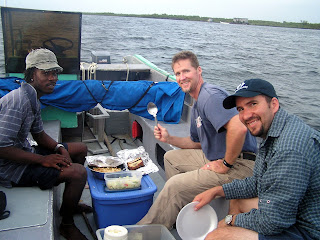 Hanging from the bow, we we wrapped it with reflective tape just in case.
Now it was time for a picnic. Not a walk in the park, but a picnic. The lagoon was calm and we made good time. We reached our destination in front of a fishing shack on the back of the island. Sitting a couple of hundred yards off shore, Alton dropped the anchor. Time to eat. We would dine on chicken, pasta, salad and banana bread that was still warm (Alton, who doesn't eat meat, had lobster tail instead). We enjoyed the peaceful rocking of the boat and good company while we dined and waited for night to come. Mosquitoes sensed our presence from shore and as the wind died they arrived. They wouldn't stay long. Darkness came early. Then thunder. Next was rain. Maybe it was a different order, but stay with me. All hell was about to break loose. Lightning raged around us, getting closer with each moment. At times the lightning was yellow. I've never seen such lightning before. Perhaps, I've never been quite so close to it. All we could do was sit, take our picture and hope that the camera would survive. Eventually the storms would give us a break and we began to work. It was croc searching time.
Thomas (whose last name is Rainwater, by the way) took his position at the bow with his spotlight (you can see some of the lightning still going behind him here). We were looking for the eye shine of a crocodile along the shore. We found one. We approached. It spooked and went under. Traveling just off of shore we scanned for eyes. Nothing.
  Then a huge reddish eye in the distance. We approached. It was massive. Getting into the water with a crocodile of this size would be suicide. It was just too big to be true. Fortunately, it really was too big to be true. It was a reflector. We moved on. Bouts of rain pelted us as we found several more eyes reflecting our spotlight back at us. One was a spider. The others were crocs, but each spooked. We weren't going to have a crocodile rodeo today.

Throughout the trip flying fish were startled by our presence . Their bodies skipped across the water around us. The the sound of their tails flicking in the water was punctuated by their bodies slapping into the water. As we approached the shallows, the sea was like a clear sky. Lights twinkled everywhere. Glowing organisms sparkled around us.
It was time to return to the dock. That meant leaving the "peaceful" lagoon to get outside of the reef. The waves were huge and we were airborne at times, unsure of when we would again be standing or sitting on the bottom of the boat. We had thought ahead. Despite the huge waves, the reflective tape that we had wrapped around the channel marker had managed to stay on. Our light reflected off of it and we knew where to pass through the reef. Alton brought us home. We drank to our "success."
(By the way, the title of this post is stolen from someone that stole it. "Picnic, lighting" is the title of a Billy Collins book and he borrowed it from Lolita -- "My very photogenic mother died in a freak accident (picnic, lightning) when I was three.")
A few of those photos aren't mine. Leslee Parr took the red eye , the picnic (no rain), and the photo of me with the light.
 Hanging from the bow, we we wrapped it with reflective tape just in case.
Now it was time for a picnic. Not a walk in the park, but a picnic. The lagoon was calm and we made good time. We reached our destination in front of a fishing shack on the back of the island. Sitting a couple of hundred yards off shore, Alton dropped the anchor. Time to eat. We would dine on chicken, pasta, salad and banana bread that was still warm (Alton, who doesn't eat meat, had lobster tail instead). We enjoyed the peaceful rocking of the boat and good company while we dined and waited for night to come. Mosquitoes sensed our presence from shore and as the wind died they arrived. They wouldn't stay long. Darkness came early. Then thunder. Next was rain. Maybe it was a different order, but stay with me. All hell was about to break loose. Lightning raged around us, getting closer with each moment. At times the lightning was yellow. I've never seen such lightning before. Perhaps, I've never been quite so close to it.
 All we could do was sit, take our picture and hope that the camera would survive. Eventually the storms would give us a break and we began to work. It was croc searching time.
Thomas (whose last name is Rainwater, by the way) took his position at the bow with his spotlight (you can see some of the lightning still going behind him here).
 We were looking for the eye shine of a crocodile along the shore. We found one. We approached. It spooked and went under. Traveling just off of shore we scanned for eyes. Nothing.
  Then a huge reddish eye in the distance. We approached. It was massive. Getting into the water with a crocodile of this size would be suicide. It was just too big to be true. Fortunately, it really was too big to be true. It was a reflector. We moved on. Bouts of rain pelted us as we found several more eyes reflecting our spotlight back at us. One was a spider. The others were crocs, but each spooked. We weren't going to have a crocodile rodeo today.
Throughout the trip flying fish were startled by our presence . Their bodies skipped across the water around us. The the sound of their tails flicking in the water was punctuated by their bodies slapping into the water. As we approached the shallows, the sea was like a clear sky. Lights twinkled everywhere. Glowing organisms sparkled around us.
It was time to return to the dock. That meant leaving the "peaceful" lagoon to get outside of the reef. The waves were huge and we were airborne at times, unsure of when we would again be standing or sitting on the bottom of the boat. We had thought ahead. Despite the huge waves, the reflective tape that we had wrapped around the channel marker had managed to stay on. Our light reflected off of it and we knew where to pass through the reef. Alton brought us home. We drank to our "success."
(By the way, the title of this post is stolen from someone that stole it. "Picnic, lighting" is the title of a Billy Collins book and he borrowed it from Lolita -- "My very photogenic mother died in a freak accident (picnic, lightning) when I was three.")
A few of those photos aren't mine. Leslee Parr took the red eye , the picnic (no rain), and the photo of me with the light.
Impersonations


 After watching the golden-fronted woodpeckers that are everywhere around here and then Alton (pictured in the backgroun), our boat driver, climb up coconut trees with ease, I thought that I'd give it a try. I was a ways up the tree before I realized that at some point I had to go down, safely. Going up was tough, but I was at a loss for how to get down. That part is going to take some practice. Next time, I'll try it barefoot. If I survive, I hope to have some pics!
(Photo credits: Top Photos-- Leslee Parr; lower photo -- Mario Mota)
Sunday, June 29, 2008
New Characters


I am way behind on posts. Sorry about that. Above are some of the characters that I met this week (the dorsal fins on the left are actually dolphins -- I'll try to post some more on them soon). We picked up a real-life crocodile guy, Thomas Rainwater, on Wednesday. He's from the south and mosquitoes don't seem to bother him (even when completely coated from head to toe). Thomas is here to survey the saltwater crocodiles that are on Turneffe Atoll.
The atoll is not a protected area and there are a number of plans to build condos (for hundreds of people!), resorts and even a golf course on the Atoll. There are a a lot of issues with doing that. For one, there is almost NO fresh water on this Atoll (only rainwater in the dry season). From what I remember, condos and golf courses use a lot of water. Besides the water issue, many mangroves would have to be cleared and many beaches would be taken over which would destroy habitat for the crocs (and other animals) and disrupt crocodile and turtle nesting sites. Mario Mota, the turtle guy that I'm working with, Leslee Parr,Thomas, and the PSU group that was here before are all working on issues associated with the potential development of this area. One goal is to document the important sites for turtle and croc nesting, so that those areas may be protected.
A bit of crocodile background
Many crocodile species around the globe are are endangered due to years of hunting and considerable clearing of their nesting sites and foraging habitat. There are four crocodile species in the western hemisphere and two species in Belize, American saltwater crocodiles and Morelet's crocodiles. You may think that crocodiles are mostly found in swampy areas, but these two species can be encountered in places that you wouldn't necessarily expect. The Morelet's are freshwater crocs. In Belize, they live in the streams and lakes on the mainland. They can often be found in clear, raging, mountain streams. Then there are the salties (they're around here). They live in the mangroves, but will come out and forage on the reefs. So you could see a crocodile while out snorkeling or SCUBA diving in the tropics, although probably only at night, or hiking along a mountain stream. The crocs in Belize dig nest cavities in the ground or build mound nests and the sex of their young is determined by the temperature at which the eggs incubate. One of Thomas' areas of research is environmental toxicology. Chemicals in the environment, such as DDT, can alter the sex-determination of the young by disrupting hormone actions. Many countries in the world use pesticides that we no longer use in the US because of their health or environmental effects. Because these chemicals are often very effective and less expensive than many of those used in the US developing countries continue to rely on them.
Shortly after Thomas arrived, he went out behind our place to look for our crocs. We have an 8-10 footer back there. He managed to grab a smaller one and then he handed it off to me (below).

It's a beautiful animal. We took a few measurements (here's Thomas with his calipers), marked it and let her go.
 While Thomas is here, we'll be looking for croc nests and surveying around the island for more crocodiles that we can grab and measure. We took the boat out last night to look for crocs along the edge of Blackbird Caye (that's where I live -- by the way, it's mentioned in Pirates of the Caribbean), but we didn't find any. We're going out again this evening to look for crocs further North. We should have more luck finding them tonight. If we find one, then we'll (i.e., Thomas) lasso it, it will start spinning until it's tired, then we'll pull it into the boat to make some measurements and mark it. Most of the folks have left the island for the night, so it will just be Thomas, our boat driver, Alton, Leslee Parr and myself. I'm pretty excited about handling a big croc. If all goes well, I'll post again soon. And if I'm lucky, I'll have some pics.
Thursday, June 26, 2008
Visiting the Island
If you don't really know where the heck I am, then go into Google Earth and paste the following coordinates into the "Fly to" bar.
17 18 21.19N, 87 48 5.42W
You'll be able to see some of the buildings that I work in or live in. Fly around the area. There's a cute little island (I posted a picture of it earlier) just south of here. Enjoy the trip.
17 18 21.19N, 87 48 5.42W
You'll be able to see some of the buildings that I work in or live in. Fly around the area. There's a cute little island (I posted a picture of it earlier) just south of here. Enjoy the trip.
Subscribe to:
Posts (Atom)